
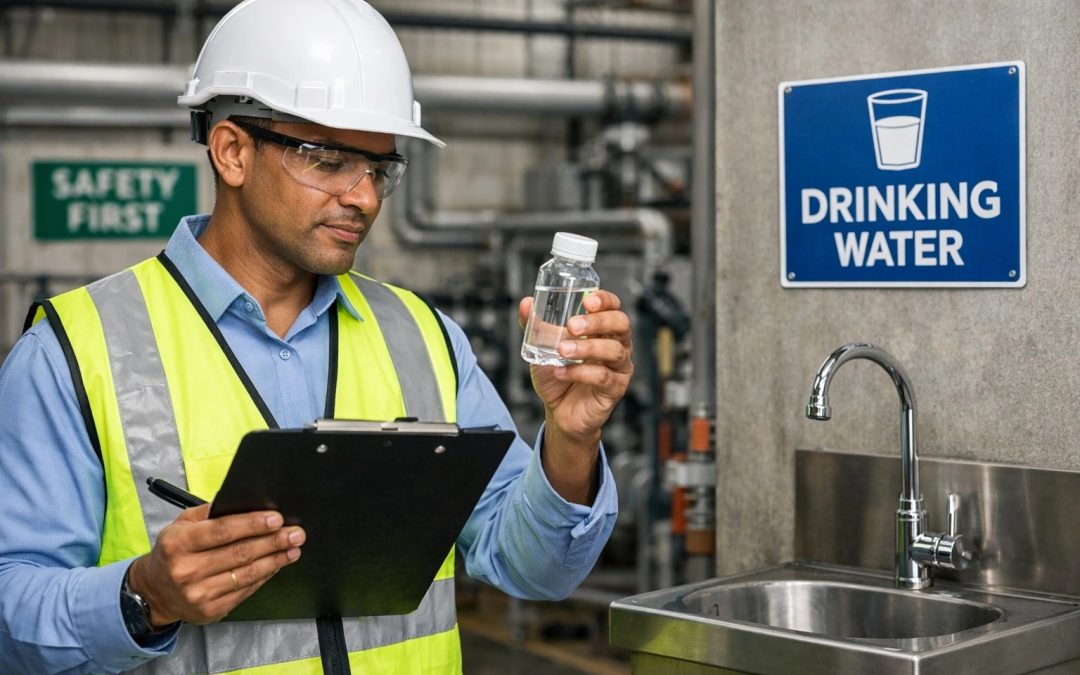
When most companies think “health and safety”, they think PPE, guarding, working at heights and risk assessments. Water is often an afterthought: open the tap, see that it is clear, and move on.
In South Africa that is not enough. Several laws and standards tie workplace water directly to health and safety. Employers must be able to show that the water their staff drink and use at work is safe and compliant. The only realistic way to prove that is regular testing.
This blog walks through the key legal pieces and what they mean in practice for factories, warehouses, offices and industrial plants.
- The legal backbone: who cares about your water
There are four main pillars that touch workplace water in South Africa:
- The Occupational Health and Safety Act 85 of 1993 (OHSA), which places a general duty on employers to provide and maintain a working environment that is safe and without risk to employees’ health, as far as reasonably practicable.
- The Facilities Regulations 2004 under OHSA, which deal with sanitation, dining rooms, drinking water and related facilities.
- The national drinking water standard SANS 241, which sets numeric limits for microbiological, chemical and physical parameters that define safe potable water in South Africa.
- The National Environmental Health Norms and Standards for Premises under the National Health Act, which require all premises to have an adequate supply of potable water and guide municipal Environmental Health Practitioners (EHPs) on how to monitor this.
On top of this, there are sector specific rules for food factories, hospitality, healthcare, cooling towers and bottled water.
Put together, they create a simple reality: if people work, eat, wash or live on your site, you have a legal duty to make sure the water is safe and you must be able to prove it.
- Facilities Regulations: “drinking water” means SANS 241 compliant water
The Facilities Regulations sit directly under OHSA and deal with basic welfare facilities in the workplace. Two key points matter for water:
- The definition of drinking water
The Facilities Regulations define “drinking water” as water that complies with SABS 241, the older name for today’s SANS 241 drinking water standard.
- The employer’s duty
They also require that every employer:
o Makes available an adequate supply of drinking water for employees at the workplace o Clearly marks taps and pipes that are not fit for human consumption
This is an important link. The regulation does not say “water that looks clear”. It ties the definition of drinking water to the national standard SANS 241.
In practice, this means that if you want to show that you comply with OHSA and the Facilities Regulations, you must be able to show that the water you call “drinking water” meets SANS 241. For that you need test results.
- SANS 241: the benchmark for safe drinking water
SANS 241 is the South African National Standard that sets the minimum requirements for potable water to be considered safe for human consumption. It specifies limits for microbiological parameters like E. coli, physical aspects like turbidity, and a wide range of chemicals and metals.
The standard is referenced in:
- The Facilities Regulations under OHSA
- National norms and standards for drinking water
- Food premises regulations
- Various guidelines and sector standards
It has also been described as a statutory requirement for treated drinking water in South Africa, meaning water suppliers are expected to comply with it.
For a factory or company, this has a simple effect. If you are providing water on site for staff to drink, cook and wash with, inspectors and auditors will expect that water to meet SANS 241. They may ask to see recent test results to confirm that.
- National Environmental Health Norms and Standards: potable water on all premises
The National Environmental Health Norms and Standards for Premises and Acceptable Monitoring Standards sit under the National Health Act 61 of 2003. They cover a wide range of premises, including businesses and state occupied buildings.
These norms require that:
- Every premises must have an adequate supply of potable water for all uses such as drinking, cooking, personal hygiene and cleaning.
- Environmental Health Practitioners must monitor compliance, using SANS 241 and related documents as key references for water quality.
In other words, even from a public health perspective, your building is expected to provide safe water, and municipal EHPs have a mandate to check this.
- Food factories, canteens and bottled water: stricter expectations
For any business that handles food, the requirements are tighter.
- The Regulations governing general hygiene requirements for food premises, the transport of food and related matters (R638 of 2018 under the Foodstuffs, Cosmetics and Disinfectants Act) define “water” used in food premises as water that must comply with SANS 241.
- National guidance for food control and bottled water standards also point to safe and adequate water that meets SANS 241, with routine monitoring by health authorities.
If your factory has:
- A staff canteen
- Food processing lines
- On-site bottling or beverage production
then water quality is both a health and safety issue and a food safety issue. Regular water testing becomes part of complying with R638, SANS 241, HACCP and any third party audits.
- Legionella, cooling towers and Hazardous Biological Agents
Many industrial sites and large buildings use:
- Cooling towers
- Evaporative condensers
- Central air conditioning systems
- Large hot water systems and spa-like facilities
These systems can create aerosols that may carry Legionella, the bacteria that causes Legionnaires’ disease. In South Africa:
- The Regulations for Hazardous Biological Agents (HBA) under OHSA apply to every employer where workers may be exposed to hazardous biological agents, including waterborne bacteria such as Legionella.
- Guidance from the National Institute for Occupational Health and the Water Research Commission highlights the high prevalence of Legionella in cooling towers and stresses that risk assessments, control measures and often regular water testing are needed to prevent outbreaks.
For companies with cooling towers or complex water systems, Legionella risk management is now an expected part of health and safety. That usually includes:
- A documented risk assessment
- A written scheme of inspection and maintenance
- Routine microbiological monitoring and Legionella testing
- Accommodation, hostels and farm housing
If your business also houses workers or seasonal staff in hostels or on-site accommodation, there are additional expectations.
For example, guidelines for worker accommodation in agriculture require that:
- Drinking water should meet the South African National Standard for drinking water and be regularly tested • Water tanks must be protected from contamination and correctly maintained
In practice, factories, mines and farms that provide accommodation are expected to treat and test their water much like a small municipality or landlord would.
- What this means in practice for “ordinary” factories and offices
You may think that most of this applies only to municipalities, food factories or hospitals. However, once you combine OHSA, the Facilities Regulations, SANS 241 and the National Health norms, the position for any employer becomes clear:
- You must provide an adequate supply of drinking water that meets SANS 241.
- You must make sure taps that are not fit for human consumption are clearly marked.
- You must manage risks from hazardous biological agents in water systems where staff can be exposed, for example cooling towers.
If you rely on municipal drinking water:
- The water service authority is responsible for bulk compliance with SANS 241, and they must test at a frequency based on the size of the community.
- However, if you store water in tanks, have complex internal piping or mix municipal water with borehole supplies, you become responsible for what comes out of the taps on your site.
- Inspectors and auditors can reasonably ask for site specific water test results at your employee drinking points.
If you rely on a borehole or other private supply:
- In functional terms, you are acting as a private water provider to your staff and visitors. • The same SANS 241 benchmarks and OHSA duties apply.
- Regular testing is the only way to show that water is safe and that you are meeting your duty of care.
This is why many risk and safety consultants now advise businesses to include water testing in their health and safety management systems, alongside other hygiene and environmental controls.
- How often should companies test their water?
There is no single magic number in law that says “every factory must test water every three months”. Instead, different documents and guidelines talk about risk based frequency.
Useful practical starting points are:
- Municipal supply, low risk office or light industrial site
o At least once per year microbiological and basic chemical SANS 241 screen at main drinking points.
o Additional testing after major incidents such as contamination complaints, visible changes in water, or plumbing works.
- Private borehole feeding staff ablutions and drinking points
o At least once per year full SANS 241 screen.
o Six-monthly microbiological checks if there is a history of problems or high vulnerability. • Food factories, canteens and beverage manufacturing
o Follow food safety systems and audit requirements, often quarterly or more frequent microbiological checks, supported by periodic full SANS 241 analyses.
- Cooling towers and high risk water systems
o Frequency set by the Legionella risk assessment, often monthly to quarterly microbiological and Legionella monitoring for medium and high risk systems.
These are not strict legal numbers for every site, but they reflect how inspectors, auditors and risk professionals expect businesses to behave if they take OHSA and SANS 241 seriously.
- What a compliant water testing programme looks like
A defensible water testing programme for health and safety should include:
- Clear scope
o Identify all points where employees drink water, prepare food or could be exposed to aerosols from water systems.
o Include ablution blocks, canteens, high risk process water and any on-site accommodation. 2. Use of accredited laboratories
o Samples analysed by a SANAS accredited laboratory using recognised methods for SANS 241 parameters and any additional tests such as Legionella where needed.
- Regular schedule
o A written schedule with frequencies based on the risk of each supply, as discussed above. 4. Documented results
o Lab certificates filed in a health and safety or environmental file.
o Summary reports that interpret results against SANS 241 and any other relevant standards. 5. Corrective actions
o Clear rules on what happens if you fail a parameter. For example: temporary use of bottled water, system disinfection, adjustment of treatment, retesting after corrective work.
- Communication
o Making sure employees know which taps are safe for drinking and what to do if they notice discoloured or bad smelling water.
This kind of programme directly supports compliance with OHSA and related regulations and gives you evidence if inspectors, unions or auditors ask questions.
- How H₂OGuru helps companies meet their health and safety duties
H₂OGuru is built around a Sample to Solution approach that fits neatly into corporate health and safety systems. For factories, offices and industrial sites we can help you with:
- Compliance testing against SANS 241
o Sampling at workplace drinking points, ablutions, canteens, boreholes and tanks.
o Laboratory analysis at SANAS accredited facilities, using SANS 241 and other relevant methods. • Specialised testing where required
o Cooling tower and hot water system microbiology and Legionella, working with specialist labs. o Process water and effluent testing to support local by-law and permit compliance.
- Plain language Clarity Reports
o One page summaries that show which parameters pass, which fail and what that means in terms of OHSA, Facilities Regulations and SANS 241.
o Simple scoring and explanations that health and safety committees can understand.
- Treatment and improvement plans
o Design of practical treatment and monitoring systems that address any failures, from simple filtration and disinfection to full system upgrades.
o Retesting plans so you can show that corrective actions worked.
- Audit and inspection support
o Documentation packs that can be placed directly into your SHE or ISO files for external auditors and inspectors.
- Your next steps as an employer or HSE manager
If you are responsible for a factory, office, warehouse or plant, the smartest starting point is simple. 1. List your water sources and main drinking points.
- Identify whether you are on municipal supply, borehole or mixed.
- Check when you last saw an actual water test result for each supply.
- Decide what level of risk you are comfortable carrying with your company’s name on it.
If there are gaps, H₂OGuru can help you design a sensible, legally aligned water testing and improvement plan that fits your health and safety system and your budget.
Safe water is not only a comfort. Under South African law it is part of health and safety. The best time to bring your water into your safety planning is before an inspector, employee or client asks the hard questions.