Headlines warning “people who drink tap water in South Africa” are hard to ignore. Recent interviews with a leading water infrastructure expert highlight a real concern: some of the measures being used to manage Gauteng’s water shortages can increase the risk of sewage-contaminated water reaching household taps. MyBroadband article
For families and businesses in Gauteng this raises a simple question: how safe is the water coming out of the tap, and what can you realistically do about it?
As a province we already sit on a tight water balance. Rand Water is abstracting close to the long term limits of the Integrated Vaal River System, and government and partners in the Platform for a Water Secure Gauteng are trying to cut overall demand by about 10 percent to keep the system stable. DWS / PWSG strategy
At the same time, national data show a decline in drinking water performance. The Department of Water and Sanitation’s own audits, summarised by researchers at the University of the Witwatersrand, found that almost half of South Africa’s monitored drinking water systems fall into an “unacceptable” category, with many towns showing serious deterioration over the last decade. Wits University opinion
So, the warning lights are real. The good news is that you can manage a lot of the risk at household and business level once you understand where that risk comes from
Why load shifting and outages affect water quality
To prevent a complete collapse of supply, municipalities are increasingly using water throttling and “load shifting”. In simple terms, water is diverted from one reservoir zone to another. That means some areas sit with low pressure or no water so that other areas can be kept alive.
From a water quality point of view there are three main problems.
- Loss of pressure in pipes
When a pipe is full and pressurised, leaks tend to spray outwards. Once pressure drops or the line drains, that same leak can start sucking in dirty groundwater or sewage from the surrounding soil, especially where sewer pipes run in the same trench. - Biofilm and sediments breaking loose
The on and off cycles create hydraulic “shocks” in the reticulation system. Experts describe this as a kind of water hammer that can strip biofilm and accumulated sludge off the inside of old pipes and send it straight to your tap. MyBroadband article - Disinfection gaps
Continuous chlorination at the treatment works is designed to leave a small “residual chlorine” all the way to your tap. Long stagnation periods, or dirty water entering downstream of the treatment plant, can reduce that protective barrier.
The Wits analysis of Johannesburg’s recent outages make a clear point. If a pipe has been empty and there is possible sewer or stormwater leaks nearby, the first water that comes back can be contaminated even if the treatment works are performing well. The recommendation is to flush until the water runs clear and to be extra careful after long interruptions. Wits University opinion
Is this just theory, or are we seeing real contamination?
Independent citizen science projects suggest the risk is already showing up on the ground. During WaterCAN’s 2025 national testing week, volunteers across all nine provinces sampled taps, JoJo tanks, rivers and household storage. In at least eight municipalities they picked up unsafe levels of bacterial contamination in water that people were drinking at home, not just in river samples. WaterCAN testing week
Put all of this together and the message is clear. Not every glass of tap water in Gauteng is dangerous. However, the conditions under which contamination can occur are now present more often, especially:
- after outages and low pressure events
- in poorly maintained buildings and complexes
- in JoJo tanks and household storage that are never cleaned
- where leaks and sewage spills are common in the street
Practical safety steps for Gauteng households
You cannot fix the bulk system from your kitchen, but you can reduce the risk to your family.
- Respect the first restart after an outage
- When water comes back, open a cold tap closest to the meter and flush until
- the water runs completely clear, and
- the spitting air pockets stop.
- Use that discoloured “first flush” on the garden or to flush toilets, not for drinking or cooking.
- If the water stays brown or has a strong smell, log a fault and use bottled or properly treated water until it clears.
- Boil or disinfect drinking water if you are unsure
Boiling is still one of the simplest barriers against bacteria. Bring water to a rolling boil and keep it there for at least one minute. Let it cool in a covered, clean container. This is especially important for babies, elderly people and anyone with a weak immune system.
- Look after JoJo tanks and other storage
In Gauteng many homes have backup tanks. They are helpful for continuity, but they can become contamination points if you neglect them.
- Keep lids fully closed and screened.
- Install a first flush diverter for roof water where possible.
- Clean tanks at least once a year to remove sludge.
- Disinfect stored water after a long period of standing, especially during hot weather.
- Maintain household filters, coolers and RO systems
Dirty cartridges and slimy cooler tanks are a common problem we see in the lab.
- Replace cartridges on schedule, do not wait until flow collapses.
- Sanitise filter housings and cooler tanks during cartridge changes.
- If you have a small treatment plant on site, schedule regular laboratory checks for Standard Plate Count and coliforms so that you know the system is still producing safe water.
- Test your water, then act on the data
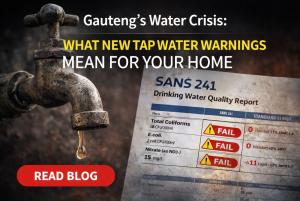
Laboratory testing is the only way to know what is really in your water. A proper SANS 241 drinking water panel for Gauteng should include:
- full microbiology (E. coli, total coliforms and Standard Plate Count)
- key physical and chemical indicators like turbidity, nitrates, chloride, sulphate and metals
- corrosion indices, especially if you have expensive plumbing, geysers or appliances
Once you have the results, the real value comes from interpretation. A specialist can explain what the numbers mean for health, plumbing and long term risk, and can recommend treatment that matches your borehole, municipal supply or storage setup.
What about the bigger picture?
Government and partners are working on structural fixes such as the Lesotho Highlands Water Project Phase 2 and a province wide strategy to cut demand and leaks. The Platform for a Water Secure Gauteng aims to reduce overall water use by about 400 megalitres per day and is building public dashboards so that residents can see system risks more clearly. DWS / PWSG strategy
Those measures are important, but they will take years to bear fruit. In the meantime, every household, complex and business in Gauteng needs a simple water risk plan that covers:
- backup storage that is safe
- routine testing of critical points such as boreholes, JoJo tanks and communal taps
- clear hygiene rules for staff who handle water bottling or coolers
- emergency steps for boil notices or contamination events
Frequently asked questions about Gauteng tap water
Is it still safe to drink municipal tap water in Gauteng?
In many suburbs the bulk water that leaves the treatment plant is still of high quality. The risk comes in through old pipes, pressure drops, sewage leaks and dirty storage tanks on the way to your glass. Some households will see no problems for months. Others in the same metro may see brown water and smell issues after every outage. The only way to know for sure at your address is to test the water from your own tap.
Does boiling water solve all problems?
Boiling is very effective for killing bacteria, viruses and parasites. It does not remove chemicals such as nitrates, heavy metals or high salt content. If lab results show chemical issues, you need proper treatment in addition to any emergency boiling routine.
Should every home install reverse osmosis (RO)?
Not always. RO is powerful, but it is not the only option. Many Gauteng homes are well served by a good sediment and carbon filter, plus a UV unit for final disinfection. RO makes sense where you have serious chemical problems or very high risk users in the house, such as immune compromised patients or babies on special feeds. The choice should be based on test results, not guesswork.
How often should I test my water?
For a normal suburban home on municipal supply, once a year is a sensible minimum, with an extra test after big incidents such as long outages or known sewage spills nearby. For borehole users, farmhouses, schools and factories, a more regular schedule is wise. In practice it often makes sense to do an annual full SANS 241 screen and midyear microbiology checks for higher risk sites.
If my results fail SANS 241, is my water finished?
Not necessarily. Many failures are fixable with the right treatment train. For example, bacteria problems can often be solved with correct disinfection, and hardness or nitrate issues can be treated with the correct media. The important thing is not to ignore the result. Use it as a design tool so that you can move from “unknown risk” to a controlled, managed system.
How H₂OGuru fits into the Gauteng water crisis
H₂OGuru is based in Gauteng and works with SANAS accredited laboratories that test water against SANS 241:2015, the national drinking water standard. Our focus is to turn confusing lab reports into clear, practical steps.
With our Sample to Solution approach, we help you:
- Choose the right sampling points on your property, whether that is a kitchen tap, borehole outlet or JoJo tank.
- Test your water at accredited labs for full microbiology, key chemicals and corrosion indicators.
- Understand your results through a plain language report that flags what is safe, what is borderline and what needs action.
- Design treatment that matches your specific water profile, from simple cartridge filters and UV units to full borehole treatment trains and backup systems.
- Retest after installation so you can see that your tap water is stable even while the wider system is under pressure.
You cannot control what happens in every municipal pipe, but you can control what comes out of the tap your family drinks from.
Contact Us For More informations
Further reading
If you want to go deeper into the background, these pieces give useful context:
- MyBroadband: Warning to people who drink tap water in South Africa
https://mybroadband.co.za/news/science/629765-warning-to-people-who-drink-tap-water-in-south-africa.html - Wits University: Is water in SA cities safe to drink?
https://www.wits.ac.za/news/latest-news/opinion/2024/2024-03/is-water-in-sa-cities-safe-to-drink.html - WaterCAN: Citizen tests reveal unsafe drinking water in eight municipalities across South Africa
https://www.watercan.org.za/news/post/press-statement-testing-week-2025-12-december-2025 - Department of Water and Sanitation / Platform for a Water Secure Gauteng: PWSG Overall Strategy
https://www.dws.gov.za/Documents/PWSG%20Overall%20Strategy.pdf