
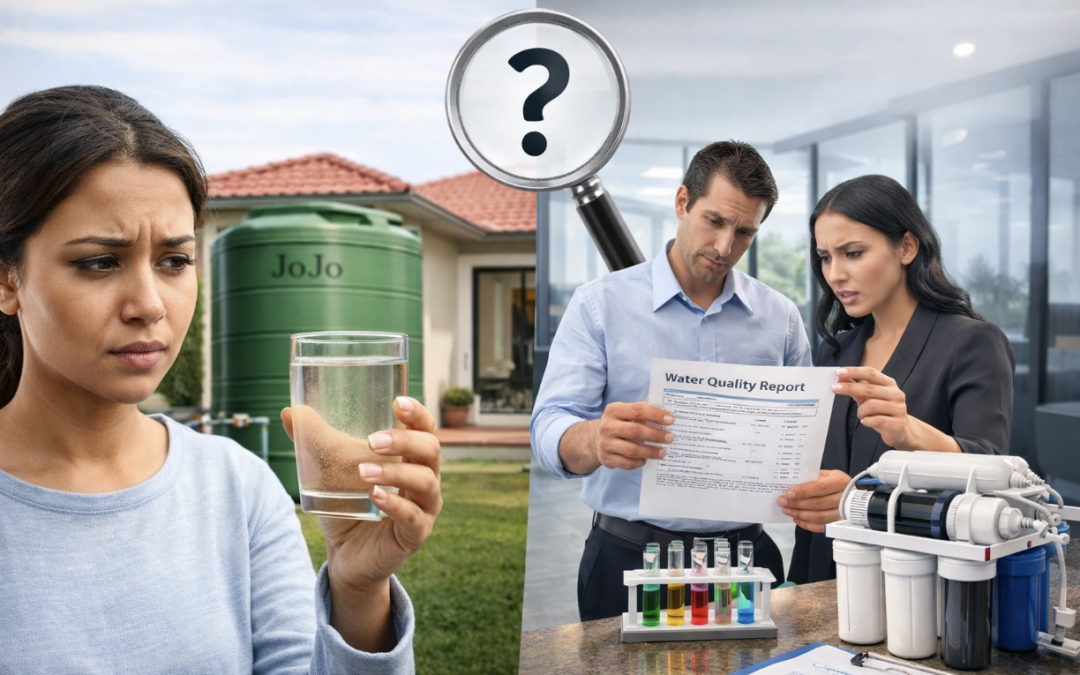
March is the best month to take water seriously in South Africa.
It is National Water Month, with National Water Week and World Water Day also falling in March. That makes it the right time for Gauteng homeowners, schools, offices, factories, guesthouses and property managers to stop asking only whether water is available, and start asking whether it is actually safe, suitable and properly managed.
Most people only think deeply about water when something goes wrong. The taps run dry. The JoJo tank smells strange. Borehole water changes colour after rain. A client asks for proof that drinking water is safe. A lab report suddenly shows bacteria, nitrate, or turbidity problems.
But the smartest water decisions happen before the crisis.
If you live or work in Gauteng, these are the seven most important questions to ask about your water this March.
- Is my tap water still safe after outages and pressure drops?
Not always.
Water can leave the treatment works in acceptable condition and still pick up problems before it reaches your property. Gauteng has seen repeated outages, low pressure events, emergency shutdowns, ageing infrastructure and localised sewage problems. All of these can affect the final quality of water at the point where people actually drink it.
When pressure drops, the risk profile changes. Dirty water, sediment and contamination can enter damaged sections of the network more easily. When supply returns, the first water coming through may carry discolouration, biofilm, loosened sediment or other contamination.
What this means in practice
If your area has had:
- frequent outages
- low pressure
- brown water events
- emergency repairs
- nearby sewage spills
then it is reasonable to question the quality of the water coming out of your own tap, even if it normally looks clear.
Smart March action
After a major interruption:
- flush the line until water runs clear
- check colour, smell and taste
- test the water if anything seems unusual
Clear water is not always safe water.
- Should I test municipal water if it looks clear?
Yes, especially in Gauteng’s current environment.
Many people assume municipal water does not need testing because it is “treated already”. But what matters most is not only the quality leaving the treatment plant. What matters is the quality at your kitchen tap, office drinking point, school tap, staff canteen or guesthouse room.
Water that looks clear can still have:
- microbiological problems
- elevated nitrates
- high turbidity not obvious to the eye
- poor residual protection after outages
- infrastructure related issues that only testing can confirm
Why testing municipal water still matters
A proper drinking water test gives you:
- a baseline for your actual property
- proof for peace of mind or compliance
- early warning before a visible problem appears
- better treatment decisions if something is off
For homes and businesses in Gauteng, municipal water testing is no longer unnecessary overkill. In many cases, it is simply responsible water management.
- When does a JoJo tank become a health risk?
A JoJo tank becomes a health risk when it is treated as storage only and not as part of a water quality system.
Many tanks are installed during a crisis and then forgotten. That is where the trouble starts.
A tank can become a problem if it is:
- poorly sealed
- exposed to dust, insects or sunlight
- never cleaned
- connected to poor quality incoming water
- feeding drinking taps without proper treatment
Common JoJo tank problems
Inside neglected tanks, you can get:
- sludge build-up
- bacterial growth
- biofilm on inner surfaces
- heat-related deterioration in water quality
- contamination through loose lids, vents or overflows
Smart March action
Ask:
- Is this tank only for flushing and backup, or is someone drinking from it?
- When last was it cleaned?
- Is the lid sealing properly?
- Should the outlet water be tested instead of the incoming line?
If the tank feeds drinking or kitchen lines, testing the tank outlet is often the most useful first step.
- How often should a borehole be tested in Gauteng?
If people drink from it, use it daily, or rely on it for household or workplace supply, it should be tested regularly.
A borehole is not automatically safe because it is underground. Borehole water quality can change due to:
- rainfall patterns
- nearby septic or sewage leakage
- changes in land use
- agricultural runoff
- long periods of non-use
- seasonal chemistry shifts
- changes in pump depth or drawdown
Borehole owners often wait too long
Many people only test a borehole when:
- the water turns brown
- there is a bad smell
- someone gets sick
- filters start blocking
- scale becomes visible
That is too late.
Smart March action
For most Gauteng properties, a better approach is:
- establish a proper baseline with a full drinking water test
- retest when appearance, taste or smell changes
- retest after major repairs, rainfall events or nearby contamination incidents
- keep a record of previous results so you can track changes over time
A borehole feeding a home, office, guesthouse, workshop or school should be treated as a real water source, not a guessing game.
- What does SANS 241 actually check?
SANS 241 is the South African benchmark used to assess whether drinking water is suitable for human consumption.
Many people hear the term but are not sure what it actually means. They assume it only refers to bacteria. It does not.
A proper drinking water assessment can include
- microbiological indicators such as E. coli and coliforms
- physical indicators such as turbidity
- chemical factors such as nitrate, salts and metals
- aesthetic and operational indicators that affect taste, smell, staining and infrastructure performance
Why these matters
Two water sources can both look clean and still be very different in quality.
One may be microbiologically safe but chemically aggressive.
Another may be chemically acceptable but bacteriologically unsafe.
A third may be safe for general use but problematic for plumbing, kettles, geysers or treatment systems.
That is why a real water assessment should not rely on one quick assumption. It should be matched to the source and the intended use.
- When do I need UV, carbon, reverse osmosis, or just proper maintenance?
This is where many people waste money.
They buy treatment first and only ask questions later. But good treatment design always starts with the water result.
The wrong order
- Water looks suspicious
- Buy random filter
- Hope for the best
The right order
- Test the water
- Understand the problem
- Match the treatment to the actual issue
In simple terms
UV is often useful where microbiological control is needed.
Carbon is often useful for taste, odour and certain organic or chlorine related issues.
Reverse osmosis may be appropriate where there are deeper dissolved chemical concerns.
Maintenance only may be enough when the real issue is a dirty housing, expired cartridge, neglected tank, or overdue service.
Smart March action
Instead of asking, “Which filter should I buy?”, ask:
“What does my water actually need?”
That question saves money and usually leads to a far better result.
- What should a factory, school, office or guesthouse test?
Any site where people drink, cook, wash, or rely on stored or alternative water should know what is being supplied at the point of use.
That includes:
- offices
- schools
- factories
- staff kitchens
- guesthouses
- lodges
- accommodation blocks
- warehouses with staff ablutions
- properties using tanks, boreholes or mixed systems
The key mistake
Many sites only think about the incoming source and ignore the final drinking point.
But if water passes through:
- storage tanks
- filters
- old building plumbing
- pressure systems
- internal pipe networks
then the water at the tap may differ from the water at the main supply.
Smart March action
Ask:
- Which taps do people actually drink from?
- Are staff and visitors drinking from tanked or borehole water?
- If someone asked for proof that this water is safe, what would I show them?
For businesses, schools and hospitality properties, a recent lab result and a clear interpretation are far better than assumptions.
Why this matters more during National Water Month
National Water Month should not only be about saving water. It should also be about managing water properly.
For Gauteng homes and businesses, that means:
- understanding where water comes from
- knowing what people actually drink
- identifying storage and infrastructure risks
- testing before there is a visible problem
- using results to guide maintenance and treatment
March is the perfect time to stop treating water quality as background noise.
A single test can tell you whether everything is fine, whether a small intervention is needed, or whether a bigger issue has been sitting quietly in the system for months.
How H₂OGuru can help
At H₂OGuru, we help homes and businesses move from uncertainty to clarity.
We work with SANAS-accredited laboratories and help clients:
- choose the right sampling point
- test municipal, borehole and tank water
- interpret results properly
- understand risks in plain language
- apply the right solution instead of generic treatment
Whether your water comes from the municipality, a borehole, a JoJo tank, or a mixed setup, the principle is the same:
Test the right point. Understand the result. Apply the right solution.
Frequently Asked Questions
Does every Gauteng home need a water test?
Not every home needs constant testing, but many homes should test at least periodically, especially after outages, brown water events, tank installation, borehole use, or repeated infrastructure problems in the area.
Is clear water always safe to drink?
No. Clear water can still contain bacteria, nitrates or other contaminants that cannot be seen by eye.
Should I test the tank or the tap?
That depends on where the risk is. If people drink from water after it passes through a JoJo tank, the tank outlet or final drinking tap is often the best place to sample.
Can a borehole be safe one year and unsafe the next?
Yes. Borehole quality can shift over time because of rainfall, nearby land use changes, septic leakage, seasonal variation and pumping changes.
Is SANS 241 only for big companies and municipalities?
No. It is the drinking water benchmark used to assess whether water is fit for human consumption, and it is relevant for homes, businesses, schools, guesthouses and workplaces.
What is the biggest mistake people make with water treatment?
Buying treatment before they know the real problem. Testing first usually saves money and gives a more reliable result.